
Text written by Esmeralda Wolf, edited by Julian Hale
Faced with a trend in which the world’s superpowers are increasingly abandoning international law and violating international human rights, it is more important than ever to challenge issues such as digital violence against women and to continue the fight for international human rights in the context of gender equality.
At a ‘Digital violence against women’ seminar organised by the European Parliament in March, this problem became abundantly clear. Misogyny and anti-gender movements are not new themes in the digital sphere, but the space occupied by this ideology is growing exponentially.
Misogynistic online content: A problem for society as a whole
Through social media, Big Tech has created an easy way to spread ideas widely, quickly and globally. Social media is being systematically used to target women in high-ranking positions (e.g. Zuzana Čaputova, the first woman elected president in Slovakia, who also spoke at the seminar) and in the public arena to try to force them to resign or withdraw from their positions.
Many of these social media platforms categorise such misogynistic content as “freedom of speech” by contrast with feminist content, which they systematically remove. As citizens, we should be aware that women are from being a minority group in society. We, women, are the opposite! However, we are systematically kept down.
Did you know that 60% of the EU’s inhabitants are women? Did you know that only 3 of the 27 EU member states have a woman as the head of their government? Or that only 30% of women appointed to government hold a ministerial post? These are the hard figures. Women did not take part in designing the democracies and systems on which our societies have been built and which are currently showing cracks. They were created by a patriarchal establishment.
In her presentation, Lina Gálvez, European Parliament Chair of Women’s Rights and Gender Equality (FEMM) Committee, argued that billions of euros are being spent to perpetuate this systematic digital violence against women, along with untold amounts of economic, political and digital power.
Women’s rights and gender equality are not just a problem for women. They are a problem for society as a whole. How can we talk of democracy when more than half of the citizens do not feel equally represented, respected and safe in society?
With the advent of Big Tech, the digital sphere has become a new public space. It is a space where women feel even less safe than in the public space we knew before. Violence in the digital sphere has real psychological, professional and democratic consequences, leading to women participating less in public debate.
You are not okay
‘You are not okay’ was the first thing that MEP Sipra Pietikäinen, a member of the European Parliament’s Women’s Rights and Gender Equality (FEMM) committee, said when she took the floor. She immediately pointed out how we as women are perceived in the digital sphere. As a woman, you are always too black, white, emotional, quiet, talkative, in short ‘too’ everything. That is what our young people hear every day online. Simply because they are who they are. Because they do not conform to the image that others want them to be. However, no one should feel inferior because of who they are. That, too, is freedom and safety.
The accusations that women receive in response to social media content they post are often downright distasteful. For example, as a young woman who writes something on a platform, you might receive a comment such as: “You should be raped in the middle of a market square and we will be there to watch and then rape you too.” Such responses are despicable. You probably feel sick to your stomach, but this is not an exaggerated example. This is the everyday language spoken to us as women, but also to our young daughters.
And there’s worse too, including explicit death threats. Such threats and insinuations are not allowed in the offline space. But on these platforms, it simply falls under “freedom of speech”, even when these threats become explicit. Although this violence is directed at women, young boys are also exposed to it and receive little to no signal that such violence is unacceptable. It is so ubiquitous that young people internalise it.
Social media should be held to the same standards as the mainstream media
The digital sphere appears to be a ‘no man’s land’, where things are permitted because they are not prosecuted. If, as a reporter, you were to include such statements in your article in the mainstream media, you would be prosecuted, as would the company, because it is against media law. Social media should be held to the same standards as the mainstream media. After all, we cannot deny or ignore the fact that it has become “the media” for a large part of the population.
One of the guest speakers was Imane Raissali, psychologist, social media content creator and voice against online harassment, known on social media as ‘Miss Raisa’. She argued that we should not demonise social media and I completely agree. It can be a place for contacts all over the world to be made, where friendships are formed and where public debate should be possible. There are many good people on these platforms, but this should not be an excuse to turn a blind eye to the dark side that is increasingly gaining ground. We must dare to recognise that the digital sphere currently functions as a no man’s land where impunity reigns because everything is classified under freedom of speech/expression.
Drawing the line between freedom of speech and violating human rights
But where are the boundaries? Where is the line that separates freedom of speech/expression from harming international human rights? A victim is a victim. Another obvious problem is victim blaming. Unfortunately, there is often still a difference in what men and women hear when they report violence against them. When it comes to women, possible provocation by the victim is often considered. We really need to get rid of that. The blame lies with the person who commits the crime.
A recent study by the Eurobarometer, which surveyed European citizens across the EU, reveals a disturbing figure: 43% of those polled believe that women are partly responsible when intimate photos are leaked and shared without their consent. This figure proves that many citizens, both women and men, judge the circumstances under which a crime is committed and still engage in victim blaming.
The major problem of intimate images being shared without consent
When a crime is committed, such as sharing intimate images without consent, the focus should not be on the existence of these intimate images. Instead, the focus should be on the crime itself and the perpetrator who shares and disseminates these images without consent. This allows us to help the victim and attempt to remove these images from the digital sphere.
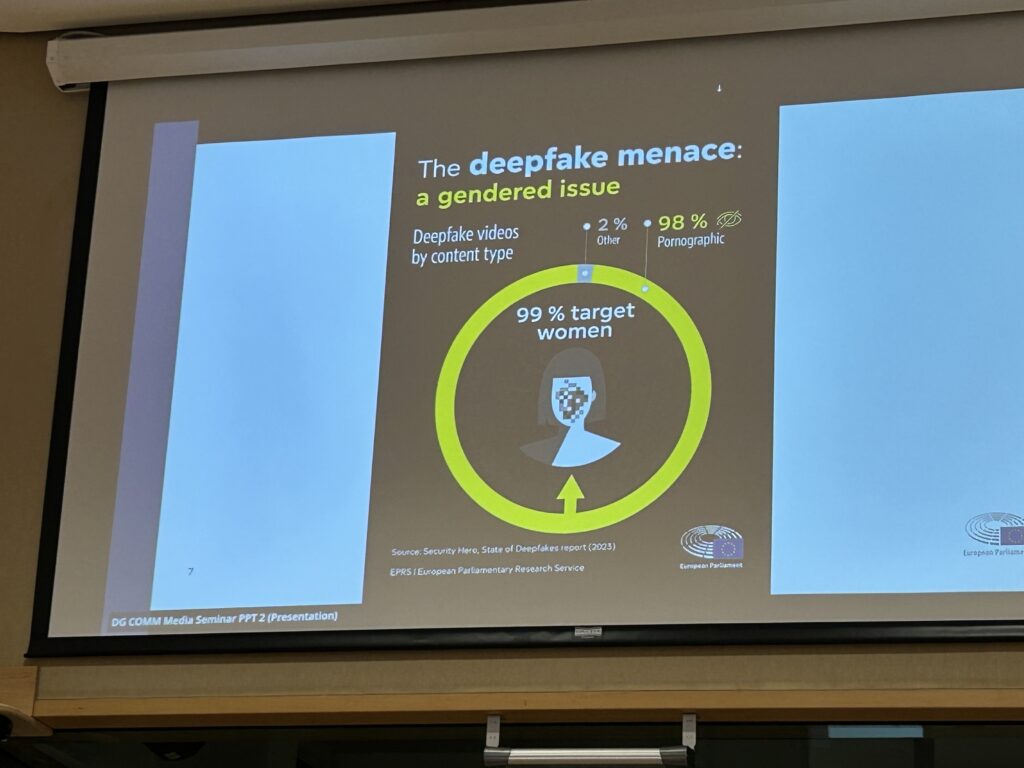
AI plays a major role in sexual violence against women. Not only are Big Tech apps designed that give people the power to create such images, such as the nudifier apps from X and Grok. Algorithms have also been systematically designed and built in which sharing such images of sexual violence, or intimate images that are forwarded, accompanied by misogynistic comments, ensures that the perpetrators of the crime receive more likes and more followers.
Through these algorithms, these platforms contribute to gender inequality and the spread of hate speech and misogyny. Currently, rules imposed by the EU in the Digital Service Act apply and platforms must comply with these rules when offering their products to EU Member States. However, although the letter of the law exists, action is often lacking or only half-hearted due to pressure from the lobbyists as well as the money and power behind these platforms. Holding them fully accountable for the content that appears on their platforms is truly essential.
Government leaders in individual countries not doing enough
Figures from the Eurobarometer and studies such as ‘The impact of the use of social media on women and girls’ and ‘Women’s rights and democracy: combatting stereotypes, disinformation and violence in the digital age’ are well known, including to government leaders in individual EU Member States. This means that they are aware of the violence and insecurity that women in their countries have to endure in the digital sphere, especially since this digital sphere has become an integral part of our current society. It is truly necessary for European countries to join forces. However, the wait-and-see attitude that our governments are adopting towards this threat to public health and the equality of their citizens, waiting for European legislation such as the Directive on combatting violence against women and domestic violence to be implemented in 2027, is a partial failure to fulfil their duty to protect the entire population of their country.
My opinion as a Belgian citizen: I am saddened to see the current lack of courage to take steps in a country like Belgium itself. In terms of safeguarding public health, especially the mental health of its young people and, by extension, the entire population, necessary steps are not being taken. What strikes me is that there is a lot of attention in the public debate when it comes to scams, with no distinction being made between men and women. There is awareness and the subject is present in the media. However, when it comes to misogyny on these platforms, there is less awareness.
When a documentary appears in the traditional media, it often draws on reports from abroad, which can also give the underlying impression that here in Belgium, “it’s not so bad”, when in fact it is. And the documentaries deal with topics that focus on what they should/can pay attention to, instead of recognising that our federal government’s role is to make public spaces, including digital public spaces, safe for all its inhabitants. What is illegal offline should also be illegal online. There is still a long way to go.
The position taken by our federal government regarding the age limit at which our children may be exposed to these platforms, despite the dangers confirmed by research, is a choice. Allowing our children, girls and boys, to be exposed to these systems on a daily basis is an act of negligence in protecting the mental health of the entire population. In the offline public space, we are more likely to see a totally different level of political engagement. When a product proves to be harmful to public health, recent examples being ‘kinetic sand’ and headphones from some manufacturers, these companies are held accountable.
Here, our government is performing its duty as protector of the people in a one-sided manner, by immediately recalling the products in question and no longer exposing its population to them. When our government knows that Big Tech media, to which its population is exposed on a daily basis, do not comply with international human rights and systematically encourage violence against the majority of its population, that same government does not take concrete or clear action and hides behind the fact that it is waiting for European legislation.
It is high time to eliminate the distinction between violence and danger in digital vs. physical public spaces and to criminalise and tackle violence in the same way. Another speaker at the seminar, Carlos Farinha, Deputy National Director of the Judicial Police in Portugal, emphasised the importance of legislation and actually enforcing it. He ended his speech with an additional recommendation. There is a need for education on this subject in school curricula. We must have a targeted prevention plan for future generations, one in which our children, boys and girls, are made aware of the impact of this systematic violence on their mental health. If this is not included now, inequality in future generations will only increase. Digital violence isn’t going away and needs to be a big part of our public debate, with actions taken to put a stop to it.