
By Julian Hale
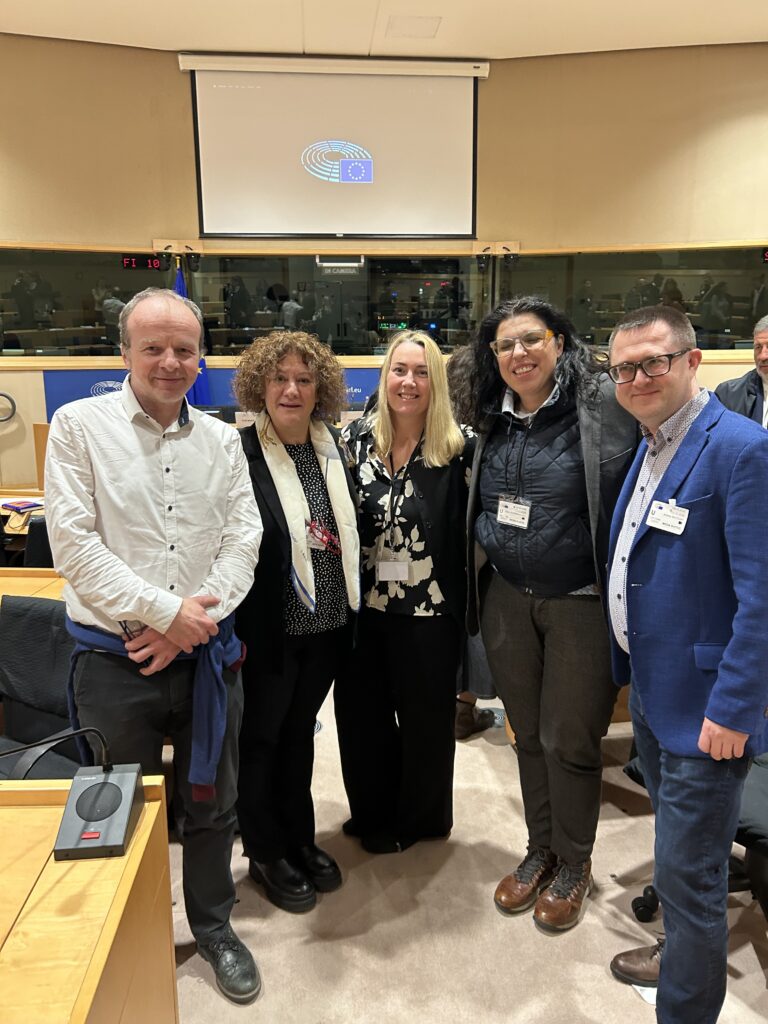
Journalists from across the EU, including Association of European Journalists members, attended a very insightful media seminar on ‘Digital violence against women’ in the European Parliament in Brussels on 6 March. The event was organised to mark International Women’s Day on 8 March.
Lina Gàlvez (Spain, Socialists and Democrats), the European Parliament Chair of Women’s Rights and Gender Equality (FEMM) Committee, kicked off the seminar by referring to a grim statistic in a study, whereby, on a platform like TikTok, within 23 minutes young men are already receiving misogynistic content. She also said some “really scary” data from the last Eurobarometer, such as that “43% of Europeans think women share some responsibility if intimate pictures are leaked without consent” and “21% of Europeans think women should accept sexist or abusive replies when sharing opinions on social media”. “98% of big fake videos are pornographic and 99% of these videos include women,” she added.
Key in countering digital violence against women is the EU’s Directive to combat gender-based violence, which was adopted in 2024, leaving EU member states until June 2027 to implement it in their national laws.
“There are some countries, my own country, Spain, which have very advanced legislation on gender based violence, but this is not the case in many other countries. So we really needed this directive,” said Lina Gàlvez (Spain, Socialists and Democrats), the European Parliament Chair of Women’s Rights and Gender Equality (FEMM) Committee.
Zuzana Čaputova, the first woman elected president in Slovakia and in central Europe as a whole, explained how she had been the target of online verbal abuse followed by death threats to her and her daughter and expressed concern that young women are being put off entering political life.
“We often speak about the crisis of democracy in Europe. We see declining trust in institutions. We see polarisation. We see populism that feeds on anger and fear. But there is another dimension of this crisis, a quiet one, yet equally profound, when women withdraw from political life because the price is too high, when young women hesitate to enter politics because the digital space is a battlefield,” she said.
She went on to say that research consistently shows that women in public life are disproportionately targeted by gender-based abuse, sexualised insults and threats of violence.
“Across the EU, approximately 30% of women have experienced cyber-harassment. Among younger women aged 16 to 29, the figure rises to 25%. These forms of hate lead to self-censorship and reduced participation in public debate, narrowing the democratic space for all.”
“We have the dark web. We have the pornographic industry making whatever kind of films and pictures of us, using children and young girls to produce entertainment. How do we let this happen?” said Sirpa Pietikäinen, a Finnish MEP from the European People’s Party. And she argued that [social media] platforms “must have the same compliance” as “our printed or online media”.
Imane Raissali, psychologist, social media content creator and voice against online harassment, recounted the psychologically damaging impact of online attacks on her in the “dark part of social media” but insisted: “Don’t demonise social media,” she said, referring to it as a tool to connect with people and develop your talent. “Social media gave me a profession and many friends.”
She said that, “on TikTok, it’s practically impossible to create content without being hated 24-7. And what the followers sometimes tell me is, okay, this is the price to pay if you want to create content. You expose yourself, so this is what you’re going to get, right? And, I mean, this speaks a lot about how people are right now in society. They justify violence all the time”.
One path towards a solution suggested by Carlos Farinha, Deputy National Director of the Judicial Police in Portugal, was to make the technology industry more responsible by developing transparency standards. He also suggested integrating digital citizenship and the use of digital tools in school materials. Portugal has a ‘Mission Safe’ scheme, developed in 2025, in which schools are visited and given information on how to avoid toxic relations online and how to use technologies correctly.