
By AEJ Belgium member Julian Hale
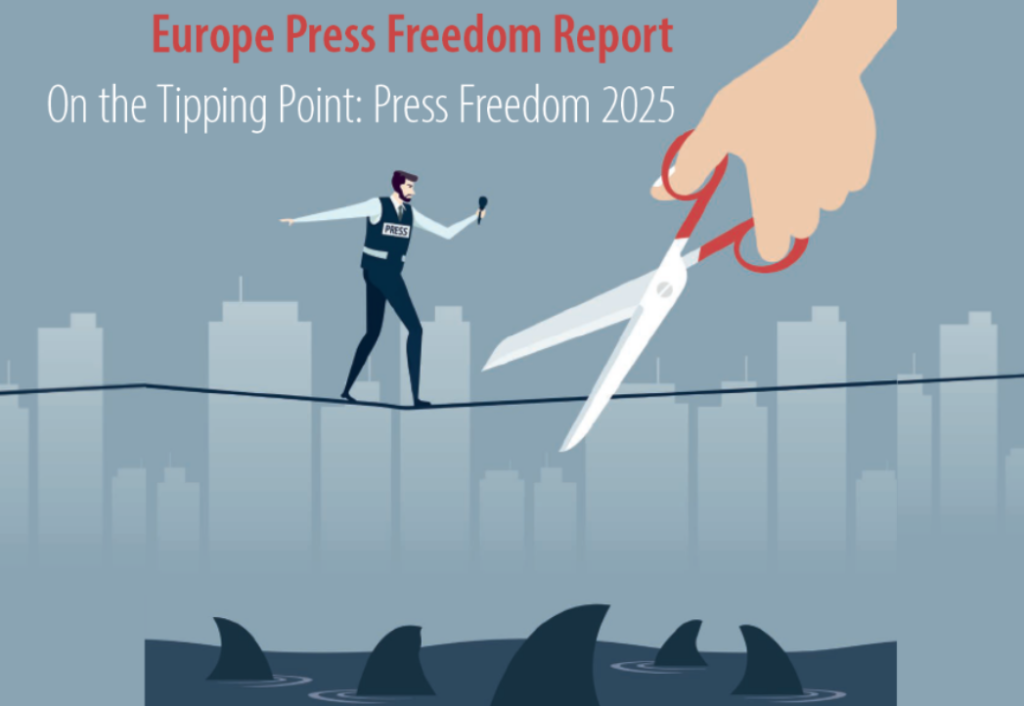
“Europe is approaching a critical juncture. Reversing the current trajectory will require decisive action by member states, the Council of Europe and European institutions to end impunity for attacks on journalists, safeguard independent and sustainably funded public service media, address structural threats such as media capture and restrictive legislation and counter online harassment and coordinated intimidation,” says the European Press Freedom Report 2026, presented on 3 March at the Press Club in Brussels.
The report is an annual assessment by the partner organisations (including the International Federation of Journalists, the European Federation of Journalists and the Association of European Journalists – full list on page 4 of the report) of the Safety of Journalists Platform.
“This requires far stronger state engagement with the Platform. In 2025, fewer than one in three alerts received a government response, and only 20% of all alerts since 2015 have been resolved, revealing a widening gap between political commitments and effective protection. Closing this gap is no longer optional: it is essential to prevent further erosion of press freedom at a moment when it stands at a tipping point.”
The platform is a Council of Europe initiative, with alerts, which are submitted by the partner organisations, documenting serious threats to the safety of journalists and media freedom in Europe. There are currently 29 active alerts, which you can read about in detail here.
Nik Williams, a policy and campaigns officer from one of the partner organisations, Index on Censorship, said that 21 journalists had been killed since Russia invaded Ukraine four years ago and 26 Ukrainian journalists were being held in Russian captivity on spurious charges related to terrorism. Describing drone strikes being used to injure or kill journalists as an “alarming development”, he also explained that trumped up charges such as terrorism, petty hooliganism and propaganda were being used to target journalists.
Gunel Safarova, Acting Director and Editor-in-Chief of Abzas Media in Azerbaijan, described a country with no independent media but only pro-government/state media, six journalists on prison on trumped up charges and over 360 political prisoners.
During the panel debate, it emerged that street protests have often become dangerous assignments for journalists in many countries, with journalists intimidated, beaten and harassed.
Women journalists being targeted
“Compared with data from previous years, women journalists in 2025 appear considerably more exposed to physical attacks, threats to life and safety and verbal harassment. To address these threats, national action plans should incorporate gender-responsive measures, including protocols for evidence capture, restraining orders and assistance with raising complaints with digital platforms, as well as systematic data disaggregation to monitor gender-based patterns of harm over time,” says the report.
Irma Dimitradze, Communications Manager and Journalist at Batumelebi & Netgazeti in Georgia said that the country had experienced a “sharp authoritarian turn” since 2022, with “lots of attacks on media, mostly public interest media”, including “physical attacks, with thousands of journalists beaten by masked law enforcement officers and equipment destroyed and never any accountability”. However, on a positive note, she said that there was lots of solidarity with journalists from Georgians, referring to a big march for freedom of speech one year after widespread media arrests. “This is a critical moment. There is no realistic chance for Georgia to go back on an EU path. But we can fight for laws to be milder or revoked and to get some prisoners released. Georgia has more political prisoners per capita than Russia,” she said.
Growing precariousnsess of the profession
“US digital platforms have disrupted the journalism funding model. They plus AI operators plunder journalistic content without financial compensation for publishers or journalists. The result is precariousness, primarily affecting freelance journalists,” said Ricardo Gutiérrez, Secretary General of the European Federation of Journalists.
In Europe, journalist are being dismissed for “doing their job too well”, he said, referring to Italian journalist Gabriele Nunziati, who was dismissed for asking the European Commission a good question about Gaza. And he pointed to job losses, e.g. 900 job cuts announced in Switzerland due to a reduction in licence fees.
Vulnerability of exiled journalists
Journalists in exile, e.g. Russian and Belarusian, are very vulnerable and are targets of repression from their own countries. “76 Russian journalists are wanted or have been convicted in absentia on politically motivated charges,” said Mr Gutiérrez.
Lots of different nationalities in Europe are not getting the security they need, said Nik Williams from Index on Censorship. “Setting up news services in exile is a costly business. Every member state needs to ensure that exiled journalists can work in countries in Europe.”
Spyware threat to journalism
“State and non-state spyware is one of the most serious and opaque threats to journalism in Europe,” said Jamie Wiseman, Advocacy Officer at the International Press Institute. Regarding spyware, he described a “worrying gap between the legal norms and practice”.
The European Media Freedom Act (EFMA) prohibits spyware, he said, yet “we continue to see the abuse of spyware in Europe”. Noting that the European Parliament’s Pegasus [spyware] Committee had put a spotlight on the issue, he regretted that none of its recommendations had been taken up by EU Member States. On a positive note, he said that there is a new working group on it and explained that there has been a criminal conviction regarding spyware in Greece, “the first time that executives of a commercial spyware company have faced charges and convictions for selling technology used to spy on a journalist. Hopefully this will lead to pushes for more justice elsewhere”.
Media capture: Governments exerting systemic pressure rather than censorship
Irina Ndava, Vice President of the Association of European Journalists, explained how governments are exerting control over media not so much via censorship but via public media management, “silencing newsrooms via structural reforms”. Problematic countries included Slovakia, Turkey (“media under presidential control”), Georgia, Bulgaria and Hungary (“where the media serves the ruling party’s agenda”).
Citing Hungary as an example of “major media capture”, Mr Wiseman said that Hungary is legally challenging the EMFA. Regarding EFMA, he said that it has been implemented in Finland, working groups have been set up and then disrupted and delayed in Bulgaria and Greece is in the midst of passing a new law.
All eyes on Hungary in the run-up to April elections
Describing Hungary as “the black sheep on press freedom”, Tamás Bodoky, Co-founder and Director of the Hungarian media outlet atlatszo.hu, explained how the government, which has been in power for 16 years, occupies, buys and consolidates media into pro-government media. “The public service media acts as a media for the governing party,” he said, with “a shrinking space for independent outlets critical of the government”.
Whilst there is no violence, the government uses legal and economic methods to restrict press freedom, “pouring money into a pro-government propaganda machine” while independent media are struggling financially. He said that, for ten years, the government had led smear campaigns and programmed attacks on media receiving foreign money, accusing them, including atlatszo.hu, of being unpatriotic and of representing foreign interests.
In 2024, he explained, Hungary set up a new authority under the Sovereign Protection Act, the ‘Sovereign Protection Office’, whose sole purpose is to go after NGOs and independent media in cases of real or not real foreign funding. One of its first attacks was on atlatszo (meaning ‘transparent’ in Hungarian), which combines investigative journalism with freedom of information requests to get information on public interest topics. The government is starting to set up battery factories in Hungary to make the country a battery manufacturing superpower, he explained. Atlatszo discovered problems with environmental pollution. In response, the government investigated atlatszo and claimed that it was spreading misinformation and laundering money. “We thought the police would come but didn’t. So we sued the Office so that they had to prove it in court. Last year, we won the lawsuit against the Office first instance,” he said. An article by the news media Telex on this can be read here. “They appealed and so the verdict is not yet final,” he added.
He also said that the government wants to introduce a ‘transparency law’ so that the Office can blacklist organisations if it finds the NGOs or media harmful to Hungarian sovereignty, effectively a ban on foreign funding designed to kill that business model. This is the media climate in which Hungary’s parliamentary elections will take place on 12 April.
Serbia
“In 2025, there were 371 cases of threats against journalists in Serbia, double the previous year,” said Dragana Žarković Obradović, Director, Balkan Investigative Reporting Network (BIRN), also referring to cyberattacks against journalists and smear campaigns. She added that, between March and December 2025, there were over 70 incidents where police passively watched violence or perpetrated violence. “There is increasing impunity,” she said, with journalists reporting incidents but nothing happening. She also said that journalists are facing criminal charges and that domestically developed spyware was discovered in 2024.
Call to engage with civil society
Aidan White from the Ethical Journalism Network called for a coalition of forces to take the recommendations from the report to society as a whole via major stakeholders such as employers and other media players. Responding, Nik Williams said that there is a need to reach, for example employers, unions and places where there are news deserts.
You can listen to the full press conference here: https://fom.coe.int/en/rapports/detail/31
And you can read the full report here: https://rm.coe.int/europe-press-freedom-report-2026-tipping-point-platform-partners-web/48802ac366